Uterine Prolapse – The Do’s and Don’ts Women Want to Know

Uterine Prolapse Professional Help For Women

Uterine prolapse is one form of vaginal prolapse in women. The risk of uterine prolapse increases in mature women however a prolapsed uterus also occurs younger women and at times prolapsed uterusthis diagnosis is made immediately following childbirth.

This Pelvic Floor Physiotherapy information outlines self management strategies for uterine prolapse problems.

Read on now to learn:

  • What is a uterine prolapse
  • Uterine prolapse symptoms
  • What causes a uterine prolapse
  • How to prevent uterine prolapse from becoming worse and protect prolapse repair surgery
  • Uterine prolapse exercises.

1. What is Uterine Prolapse?

Uterine prolapse is a “fallen down” uterus or womb slipped out of position. It happens when the uterus (or womb) loses its strong supports that hold it up inside your pelvis.

The uterus is held up and in position inside the pelvis by a combination of strong ligaments (imagine ropes holding it up from above), and the pelvic floor muscles (supporting your uterus from below). When these supports fail inside the uterus moves down within the pelvis, and the cervix, or strong muscle around the neck of the uterus moves down inside the vagina. This illustrates the importance of strong healthy pelvic floor muscles if your have been diagnosed with a uterine prolapse and after prolapse repair surgery.

2. Uterine Prolapse Symptoms

A prolapsed uterus may present with a number of different symptoms. When the prolapse is very mild you may have no symptoms. Uterine prolapse symptoms tend to become more apparent as the prolapse becomes worse including any of the following:

  • A bulging, heavy/dragging feeling in the vagina;
  • A lump coming down inside the vagina;
  • A heavy feeling in the abdomen or pelvis;
  • Difficulty inserting tampons;
  • Difficulty emptying the bladder; and
  • Low back discomfort.

3. What Causes Prolapsed Uterus?

Some common causes of uterine prolapse include:

  • Pregnancy and childbirth that causing damage to the pelvic floor during birth such as prolonged pushing, multiple births and large babies. Note that injury to your pelvic floor during childbirth may not become apparent until many years later!
  • Postnatal pelvic floor injury caused by constipation and/or inappropriate exercise.
  • Chronic constipation and straining
  • Chronic coughing and/or sneezing
  • Wasting of the supportive structures in your pelvic floor during and after menopause
  • Obesity
  • Heavy lifting
  • Inappropriate exercise including high impact exercise, heavy weight training and intense abdominal or core exercise.

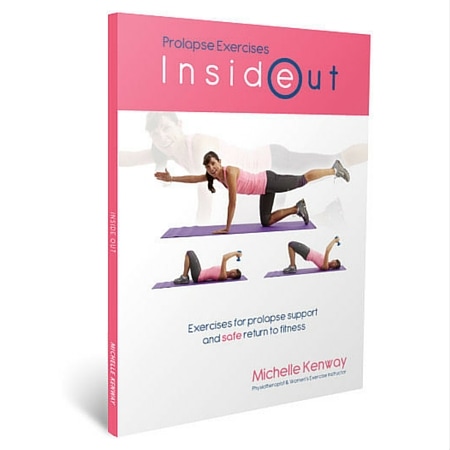
For comprehensive guidelines for uterine prolapse exercises to avoid and choose refer to Inside Out – the essential women’s guide to pelvic support by Michelle Kenway Pelvic Floor Physiotherapist and Dr Judith Goh Urogynaecologist.

4. How to Protect after Uterine Prolapse Surgery?

There are a number of important steps you can take to manage your prolapse and protect your prolapse repair if you have taken the step of having prolapse repair surgery.

Avoid:

  • Straining/constipation (seehow to overcome bowel movement problems to learn how to empty and avoid straining);
  • Heavy lifting, pushing/pulling, bending;
  • Smoking (to reduce coughing);
  • High impact sports (e.g. jogging, sit-ups, horse-riding, high impact aerobics);
  • Heavy resistance training;
  • Intense core or abdominal exercises; and
  • Becoming overweight.

Do:

  • Pelvic floor muscle exercises – start pelvic floor exercises after surgery when you have your specialist’s approval to commence;
  • Wear quality support briefs (underwear);
  • Speak with your specialist about the possibility of being fitted with a support pessary. A pessary is a prolapse support device that sits high inside the vagina. Many women find that using a pessary device helps them exercise their pelvic floor muscles and supports their prolapse;
  • Practice good bowel habits (e.g. never strain);
  • Alternate activities (e.g. sitting/standing) and avoid prolonged standing especially when you are recovering from pelvic floor repair surgery;
  • Do tasks early in the day;
  • Split tasks (e.g. do vacuuming over a few days rather than all in one day);
  • Manage your weight and lose weight if you are overweight;
  • Have a rest in afternoon and elevate your legs if possible;
  • Try to maintain good posture;
  • Speak with your doctor to manage chronic cough, chronic hay fever and sneezing; and
  • Choose low impact pelvic floor safe exercise.

5. Uterine Prolapse Exercise

You need to be very careful about the types of exercise you perform to avoid worsening your uterine prolapse and after surgical repair for a prolapsed uterus (when you have your specialist’s approval to exercise). Many everyday exercises can increase pressure on your pelvic floor and worsen your prolapse or even contribute to repeat prolapse after already having had prolapse surgery. Unfortunately many fitness instructors are unaware of the potential for this kind of injury with exercise so that you need to make sure that you are fully informed about the exercises that are appropriate for you if you are living with a prolapse.

1. Pelvic floor safe fitness exercise

Fitness exercise should be be low impact to protect your pelvic floor - this means keeping at least one foot on the ground as you exercise. Ideal low impact fitness exercises include:   uterine prolapse exercises
  • Cycling
  • Walking
  • Dancing – low impact types
  • Bush walking
  • Swimming

2. Pelvic floor safe strength and abdominal exercises

Use caution when choosing strength and abdominal exercises:

  • Avoid unsafe abdominal exercises and abdominal exercise machines to minimise downward pressure on your pelvic floor
  • Avoid inappropriate strength exercises and use protection strategies for strength training such as leg press and wide leg squats that increase pressure on your prolapse
  • Avoid heavy lifting and straining when lifting weights
  • Choose seated positions for all your strength wherever possible to support your pelvic floor
  • Avoid holding your breath when lifting weights and breathe out with all effort whether it be a lift/lower/push or pull.

We welcome your comments about uterine prolapse

For more exercise guidelines and safe strength and fitness workouts for women with prolapse conditions please refer to Inside Out – the essential women’s guide to pelvic support by Physiotherapist Michelle Kenway and Professor Judith Goh Urogynaecologist.

Please read our disclaimer regarding this information.

This information is provided for general information only and should in no way be considered as a substitute for medical advice and information about your particular condition. While every effort has been made to ensure that the information is accurate, the author accepts no responsibility and cannot guarantee the consequences if individuals choose to rely upon these contents as their sole source of information about a condition and its rehabilitation.

Copyright © Pelvic Exercises.com.au

Comments

  1. corolla says:

    I wish I could write like you as Margaret Laurence once said “When I say “work” I only mean writing. Everything else is just odd jobs.”

  2. Shann Weston says:

    How about uterine prolapse and zumba? This is very popular now. These are a lot of latin dance steps and one knee high step, alternating legs that is popular.

    • Pelvic Exercises says:

      Hi Shann,
      Thanks for your question regarding uterine prolapse and zumba. I don’t see an issue with basic low impact and single leg lift dance steps and uterine prolapse. The issues arise when the exercises or dance steps become high impact with both feet raised off the ground at once. If an exercise or dance step has at least one foor on the ground at all times, then it is low impact and usually pelvic floor-friendly in that it won’t put the pelvic floor under strain. The key to protecting a uterine prolapse and participaing in exercise classes such as zumba is to keep the steps low impact and avoid jumping dance moves. Thank you for your imput Shann, Michelle.

  3. Definitely good contribution, I basically rely on up-dates within your stuff.

  4. Debra says:

    Do you know if the pelvic prolapse surgery including a hysterectomy is less time recovering if it is done with the davinci robotic surgery?

  5. Pat says:

    Hello – I have just been diagnosed with Uterine prolapse and do not want to have surgery! I have osteoporosis and now feel at a loss about what I should do to address the prolapse as well as getting cardio exercise, walking is uncomfortable at times.  I do Qi Gong twice a week and have just started to learn Tai Chi.  I am 77 Years old.  Any help or suggestions would be greatly appreciated.  Thank you.

    • admin says:

      Uterine prolapse and exercise

      Hi Pat

      I sympathise with your dilemma as exercising for osteoporosis with a uterine prolapse can be a real challenge, especially if your prolapse is uncomfortable. I will answer your question 2 parts as I am not exactly sure whether you are aiming to exercise for your cardiovascular health specifically, or whether you are attempting to address your bone density with exercise.

      The best choices for cardiovascular fitness and to protect a uterine prolapse are low impact exercises meaning at least one foot is in contact with the ground at all times. This reduces the impact and pressure on your pelvic floor and prolapse.
      Appropriate low impact exercises with a uterine prolapse include:

      - Stationary cycling
      - Water based exercises such as water walking and swimming
      - Walking (only if comfortable – some women find that small bouts of walking during the day especially wearing good support briefs are manageable rather than one long walk).

      Unfortunately appropriate exercise for osteoporosis involves high impact activity which is completely inappropriate with a uterine prolapse that is symptomatic with walking. Resistance exercises are the other appropriate type of exercises to address bone health however these do not improve cardiovascular fitness. There are a number of resistance exercises that most women can still perform despite their uterine prolapse.

      I hope this gives you some idea about your exercise options Pat
      Kindest regards
      Michelle

  6. lyia says:

    hi,
    While inserting copper T, my gyno said that my uterus is low and not to lift weights. Is this what you call uterine prolapse?
    My legs and thighs are obese and I've planned to reduce them through excercise. Please guide me on what to do?
     

  7. Donna says:

    Hi, I have a prolapse of the uterus and vaginal wall. I also have an injured back from lifting my large baby. I am working on ways of lifting him correctly to reduce more problems with my prolapse and my back. I am finding both problems aren't getting better as I cannot do the core strntheing exercises to fix my back as it will make my prolapse worse. Any suggestions? Thankyou

  8. Carisma says:

    Hi,
    Have just been diagnosed with uterine prolapse and I was wondering will riding my horse (an ornery, but gaited Tennessee Walker) make the condition worse?

  9. Mini says:

    I am 45, and after a pretty sedentary life for about fifteen years prior along with obesity, I have been doing situps, leg lifts, Chi Lel Qi Gong by Luke Chan, at home with a DVD, and plenty of outdoor work that requires lifting and other actions, that would assist anyone with weak muscles to push and strain in and around that area, and have never had a problem with a prolapsed uterus. Could be that when the lower back and lower abdominal muscles get weak, the legs and other relative body parts particularly in the areas of the anus and bladder work differently, and much harder, to compensate for those weaknesses that the problem occurs. Experience has told me that when there is weakness there is a tendency to use the wrong muscles of the body and there is jeopardy of the the uterus being pushed out of the opening. There is no denying that, when paying close attention, it can be felt when it is being put under stress and strain and that is evidence that the wrong muscles are being used. I am living proof that it is possible to do sit ups and leg lifts, mild to moderate ones, without a prolapse coming on when the correct muscles are used-not those surrounding the immediate area of the uterus so much. When it can be felt that there is pushing going on inside then it is time to learn how to use the muscles that will not do that.

    • Michelle Kenway says:

      Hi Mini

      Thanks so much for your comment. Yes agreed entirely, it is possible for some women to perform exercises such as double leg raises without any trouble at all. It may well even be that some women with well functioning pelvic floor muscles become even stronger through their pelvic floor with sit up exercises, as the pelvic floor needs to contract to counteract the associated downward pressure of the exercise. But for those women whose pelvic floor muscles are not functioning well, or for those women who are at increased risk such as women with a prolapse or after previous prolapse surgery, then these women may sustain pelvic floor injury with these types of exercises.

      It is great to hear this input asit is important that women know that the same exercises are not necessarily indicated for everyone. Different exercises are suited to different women’s bodies that’s for sure.

      Cheers
      Michelle

  10. Sand says:

    Hi I have a uterine prolapse but keep putting off the hysterectomy as I cannot afford four weeks in bed due to work and family commitments. Sometimes it feels as if all my insides are falling out through my vagina. Do you think an op can be avoided or will the situation only get worse? I am 45 year old with two kids. Thanks for the useful info and comments,
    Sand

    • Michelle Kenway says:

      Hi Sand
      This will largely depend on the severity of your prolapse, and symptoms do not always indicate the severity i.e. a woman with a mild prolapse may actually experience quite a degree of discomfort. Seeing a trained pelvic Floor Physiotherapist would be a good start for you to help assess the severity of your prolapse, identify and address those factors potentially worsening your symptoms, and to assist with pelvic floor rehabilitation. Another alternative to consider is a vaginal pessary to support your uterus. There are many pessaries on the market to suit different prolapses, and different needs – a good start would be to speak with a gynaecologist about the possibility of using a pessary. In Australia some Pelvic Floor Physiotherapists are starting to fit pessaries too. Another factor to consider in menopause at which time your oestrogen levels fall, weakening the pelvic floor and it wil be important to attend to good pelvic floor strengthening.

      There has been some recent research supporting the fact that pelvic floor exercises can alleviate prolapse symptoms, so this is worth pursueing. In fact it really is a win-win situation as this type of rehab. may very well improve prolapse surgery outcomes also buy minimising the risk of recurrent prolapse. Unfortunately some women don’t anticipate the fact that recurrent prolapse is a risk post-op.

      I hope this information helps to provide you with some alternatives Sand, Michelle

We Welcome Your Comments

*