Pelvic Floor Physiotherapy Prolapse Exercise Help for Women
These prolapse exercise guidelines teach you the most effective way to strengthen your prolapse support and alleviate prolapse symptoms.
Read on now to learn the answers to these prolapse questions: 
- What is prolapse exercise?
- How can prolapse exercise help?
- Who can benefit from prolapse exercise?
- Can exercise fix a prolapse?
- What is the correct exercise technique?
- How many exercises? How often?
- Common mistakes to avoid
- How long will it take to see exercise benefits?
Download Prolapse Exercise guidelines as a user friendly PDF by scrolling down page.
What is Prolapse Exercise?
Prolapse exercise is exercise designed to improve prolapse support and protect a prolapse from worsening. Prolapse exercises are specifically for the pelvic floor muscles and are known as pelvic floor exercises. Pelvic floor exercises strengthen and help to restore the pelvic floor muscles.
Prolapse occurs when the pelvic floor muscles and tissues weaken and stretch. This decreases support for the bladder, uterus and bowel (pelvic organs). When these organs lose support they can prolapse or bulge into the walls of the vagina (cystocoele, rectocoele), move down into the vagina (uterine prolapse) and/or protrude from the rectum (rectal prolapse).
How Prolapse Exercise Helps
Prolapse exercise involves training and rehabilitating the pelvic floor muscles. Prolapse exercises aim to: 
- Increase the strength and thickness of muscles for prolapse support;
- Lift the pelvic floor to sit higher within the pelvis; and
- Increase the stiffness of the pelvic floor making it more resistant to strain.
Pelvic floor exercises may assist prolapse sufferers in a number of ways:
- Reduce prolapse symptoms;
- Delay or avoid prolapse progression;
- Improve prolapse support following prolapse repair surgery;
- Improve bladder control; and
- Improve bowel emptying.
Who can Benefit from Prolapse Exercise?
Pelvic floor exercises can help to reduce and in some cases overcome prolapse symptoms in women with mild to moderate prolapse. It may well be that improving prolapse support can delay or avoid a prolapse from worsening.
Women with severe prolapse are prescribed pelvic floor exercises to improve the outcomes of prolapse repair surgery by improving pelvic floor support. Women with severe prolapse may benefit from strengthening their pelvic floor prior to prolapse surgery rather than waiting until after it has taken place.
Can Exercise fix my Prolapse?
No, it is not possible to completely fix a prolapse with pelvic floor exercise. A prolapse is like a hernia of the pelvic floor tissues. The only way to completely repair a prolapse is via prolapse surgery. Exercises can however improve prolapse symptoms and restore pelvic floor strength and support.
Prolapse Exercise Technique
Pelvic floor exercises for prolapse involve lifting and squeezing the pelvic floor muscles. This feels like and involves a lift and inwards squeeze of all three pelvic openings (vagina, urine tube/urethra and anus).
Exercises for prolapse feel like:
- Lifting and squeezing in and around the anus or back passage as if trying to avoid passing wind;
- Lifting and squeezing inside the vagina; and
- Lifting and squeezing in and around the entrance to the urethra (urine tube) as if trying to stop or slow the flow of urine.
Tips for Prolapse Exercise
- Reposition your prolapse within your vagina before your exercises if it tends to protrude;
- Commence your exercises lying down to minimise drag on your pelvic floor;
- Attend to your posture, slumped posture decreases the effectiveness of pelvic support exercises;
- Practice your exercises at the start of the day when your prolapse will not be dragging as much as at the end of the day; and
- Using a vaginal pessary may help to lift the prolapsed tissues off the pelvic floor, thereby making pelvic floor exercises easier to perform with a prolapse.
How Many Pelvic Floor Exercises? How Often?
- Pelvic floor exercises for prolapse support should be performed daily;
- Aim to perform up to 8 pelvic floor exercises in a row;
- Try to maintain each exercise for up to 10 seconds;
- Relax and rest your pelvic floor muscles between every attempt; and
- Repeat this up to 3 times daily for a maximum of 24 daily exercises.
When starting out
If your pelvic floor is weak it is unlikely that you will be able to initially perform this quantity of exercise. Focus upon using the correct technique and maintaining your pelvic floor muscle contraction for as long as you are able to do so. For some women this will initially be for 1-2 seconds a time. Gradually build up the duration of your pelvic floor muscle exercises and the number you can perform in a row as your strength improves over time.
Common Mistakes to Avoid
- Pushing the pelvic floor down rather than lifting it up;
- Breath holding during pelvic exercises – breathe normally throughout; and
- Squeezing the buttocks and thighs instead of the inner pelvic floor muscles.
How Long to Strengthen?
It can take up to 5-6 months of regular exercise to strengthen weak pelvic floor muscles. Some women start to notice that their prolapse symptoms start to decrease 3-4 weeks of daily pelvic floor exercise
Pelvic floor exercises for improved prolapse support will only benefit women with intact pelvic floor muscles. Women with prolapse who do not notice any improvement in their pelvic floor strength, and those who are unable to contract their pelvic floor muscles should seek pelvic floor rehabilitation treatment from a trained health professional.
Download Prolapse Exercise guidelines as a user friendly PDF
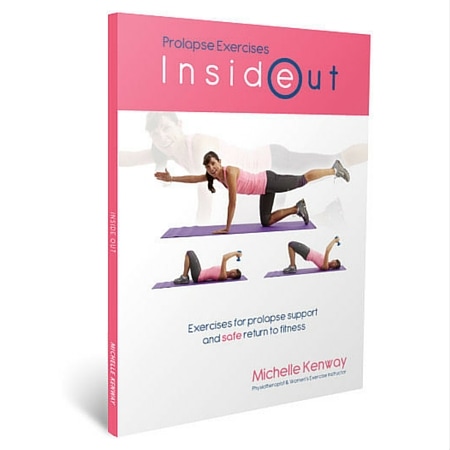
‘Prolapse Exercise’ is by Michelle Kenway, Pelvic Floor Physiotherapist. Michelle is the author of the internationally acclaimed guide for women Inside Out – the essential women’s guide to pelvic support
We welcome your comments about ‘Prolapse Exercise’ below
Please read our disclaimer regarding this information
This information is provided for general information only and should in no way be considered as a substitute for medical advice and information about your particular condition. While every effort has been made to ensure that this information is accurate, the author and publisher accept no responsibility and cannot guarantee the consequences if individuals choose to rely upon these contents as their sole source of information about a condition and its rehabilitation. Pelvic exercises accept no liability to any person for the information or advice provided, or for loss or damages incurred as a result of reliance upon the material contained herein.
Copyright © Pelvic Exercises.com.au
Can you do walking if you have grade 2 uterine prolapse, rectocele,, etc. How long can you walk?, how far?, Do you need special walking shoes?
Hi Renee
Thanks for your questions!
What any woman can do for exercise with a prolapse is really determined by how well her pelvic floor is functioning. The pelvic floor supports the pelvic organs with exercise and activity. Regular low impact exercise such as walking is usually suitable for most women with mild to moderate pelvic prolapse such as yours, however for some women with more severe prolapse find that even walking and standing becomes very uncomfortable.
There are no hard and fast rules on the time/distance to walk with a prolapse since every woman is different. Based upon the ACSM guidelines for exercise for general fitness, aerobic exercise such as walking should be 30 minutes on 5 days a week for healthy adults.
Well cushioned footwear, keeping walking surfaces flat and even wearing supportive briefs or gym pants may help to reduce impact and improve support a little. Some women choose to do shorter walks (3 lost of 10 minutes) plus walk when rested not fatigued may help too. Some women choose to use a pessary for exercise and this is an excellent option for some women to help them to exercise for fitness with a prolapse. A vaginal pessary needs to be prescribed and fitted by a gynaecologist for those women suited to using a pessary.
Hope this helps you Renee
Michelle
Can you use a staionary bike if you have uterine prolapse? treadmill, etc.
Hi Renee
With uterine prolapse it is advisable to keep fitness exercises low impact. Staionary bike is one such exercise that is pelvic floor friendly placing minimal impact on the pelvic floor. It is advisable that to keep cycling forces on the pelvic floor low, stay seated in the saddle and avoid using heavy gears. Better to use light gears and high revolutions for your fitness and weight management exercise.
Hope this helps
Michelle
Will dancing make my uterine prolapse worse? (swingdancing, hand dancing, ballroom dancing, etc.
Hi Renee
Dancing is a great form of exercise and is usually (not always) low impact. You can estimate the load on your pelvic floor associated with dancing by judging whether or not at least one foot is in contact with the ground as you dance. This means that dancing with alot of higher impact jumping is best avoided. The speed will come into it too – in thinking about swing dancing probably the faster ther music the greater the impact? I may stand corrected on this but I would think that slower dancing would be more likely to be lower impact. Ball dancing as I understand it would seem an ideal form of low impact exercise and activity with a prolapse.
Cheers
Michelle
Your articles are really very helpful, especially when the doctors tell me that its fine to excersize however I want to! Can you tell me if if is relitvly safe to take a Zumba dance class with prolapse repairs?
Hi Teri
Zumba is usually low impact and therefore appropriate exercise when fully recovered post repair for most women however this can vary from one instuctor to another so it is wise to understand low impact versus high impact exercise. The idea is to modify high impact exercises that involve jump/hop and make them into a low impact step so that at least one foot stays on the ground as you exercise.
Cheers
Michelle
Hello!
Do you have exercise video appropriate for me? Easier motivation for me Here is my situation in brief. Thanks so much for your valuable time.
I purchased your book and really got a lot of info. Bought in 2011. Had rectal tack, anterior bladder repair and lost uterus and cervix in surgery after visit to docter when felt prolapse after voiding. Placement of mesh also. After 3 years still have a little “wettness” on exertion. Constantly had setbacks with pushing clutch and yoga exercises- Surgeon (urogyn) advised do anything that felt OK and clutch not a problem in driving the Toyota. Exercises felt Ok then each many times I realized I hurt myself after activity. Got an automatic car finally. Surgeon said when asked abouth pelvic exercises “why would you want to do that you don’t have a vagina” . I stopped seeing him – he had no answers for me and eventually 1 year just as I was able to pick up more the bladder fell and was repaired by a urologist. Urologist read surgery report and said temporary stitches were used for the repair. I still have no idea why.
After 2 years from last surgery, I am finally able to pick up gallon milk carton without pulling but still have wetness on occasions of too much activity. Bending is easier now. I am super careful and can’t stand long periods but can do lots more. I did physical therapy for last surgery and am faithful to kegels and swim. Still have little setbacks for a day or two when standing a few hours.
Hopefully you have video appropriate for me or some suggestions on where to go from here or if you think full recovery is possible in time. I have been told the only way to find out what is going on is mri – but still might not tell what is happening in there- or exploratory surgery -( I am worried about possibly more adheseions or problems after another surgery). What would you do in my case? Limited ability to do my ususal profession has caused financial difficulty so MRI is out- high deductible and live in the US. I hope you have a suggestion and an exercise video appropriate to me.
Sincerely,
C Bisseling
Hi Carol
It sounds as though you are on the right track with your Kegels, swimming and understanding those activities that impact upon your pelvic floor.
Upon reading your history my first impression is that you would probably benefit from seeing a pelvic floor physio to help you establish how well your pelvic floor muscles are working, and where to focus your efforts in terms of training pelvic floor muscle strength/endurance and using ‘the knack’ to pre brace your pelvic floor for specific functional activities. I will post a video on using ‘the knack’ in the next few days. This would also help to establish how appropriately you are training your pelvic floor at present and whether or not to your best possible advantage – you need to be training your pelvic floor as effectively as possible.
Other factors that maybe impacting upon your pelvic floor also need to be considered; your body weight, your bowels, any respiratory/chest/allergies, medications, coexisting back/pelvic joint pain problems, fluid intake/type, bladder irritants, hormonal status etc as there are so many factors that can impact upon the pelvic floor, continence and prolapse recovery.
With regards to safe exercise for prolapse, your best choices are low impact exercises and you can read all about these and perhaps start using this prolapse link. As far as exercise DVD’s go, I made Inside Out Strength exercise DVD for women with prolapse or previous prolapse repair seeking a pelvic floor safe strength training workout. It is based upon the Inside Out book you have already read, and goes further with additional strength exercises and a kegel workout. So this would be a good place to start if you are seeking to strengthen your whole body and protect your pelvic floor. If you are seeking to improve your cardiovascular fitness, then swimming, water walking, cross trainer and similar low impact exercises are pelvic floor friendly and appropriate for many women with prolapse.
I hope this provides you with some direction Carol, and please feel most welcome to comment further with any further questions.
Michelle
I have a bladder prolapse and it is hurting to much to stay physical. I love running, excersicing anyway and horse back riding, so I am going crazy not being able to do aroebic type activity. Whcih is better a stationary bike or recumbandt bike. I am currently waiting for you book to arrive!
Hi Anita
Whether or not to use a recumbent or upright bike is a very individual decision – I suggest that you go to a sports store and try out both styles of bike for comfort, and for the ability to adjust the resistance levels and set up to suit your body. Some women find that leaning forward in upright aggravates back problems, while others find various seating arrangements more or less comfortable. Both styles of bike are low impact and therefore good options for pelvic floor safe exercises. Some women with pelvic pain need to be cautious when it comes to the pressure of the seat on their pelvic floor but this doesn’t sound to be your issue.
Michelle
Thank you so much for this website and for the utube videos. I am recently diagnosed with moderate prolapse and am seeing a physiotherapist and she is telling me to do EXACTLY what you are saying. I feel so much better hearing someone else like you tell me the same thing. I want to avoid surgery and strengthen myself enough to relieve some of my symptoms and your videos and website give me great hope, thank you so much for sharing your in depth knowledge of this unspoken problem and for giving me confidence that I am doing all I can to try to fix my prolapse in a conservative manner. Best Regards!!!!!!!!!!!!!